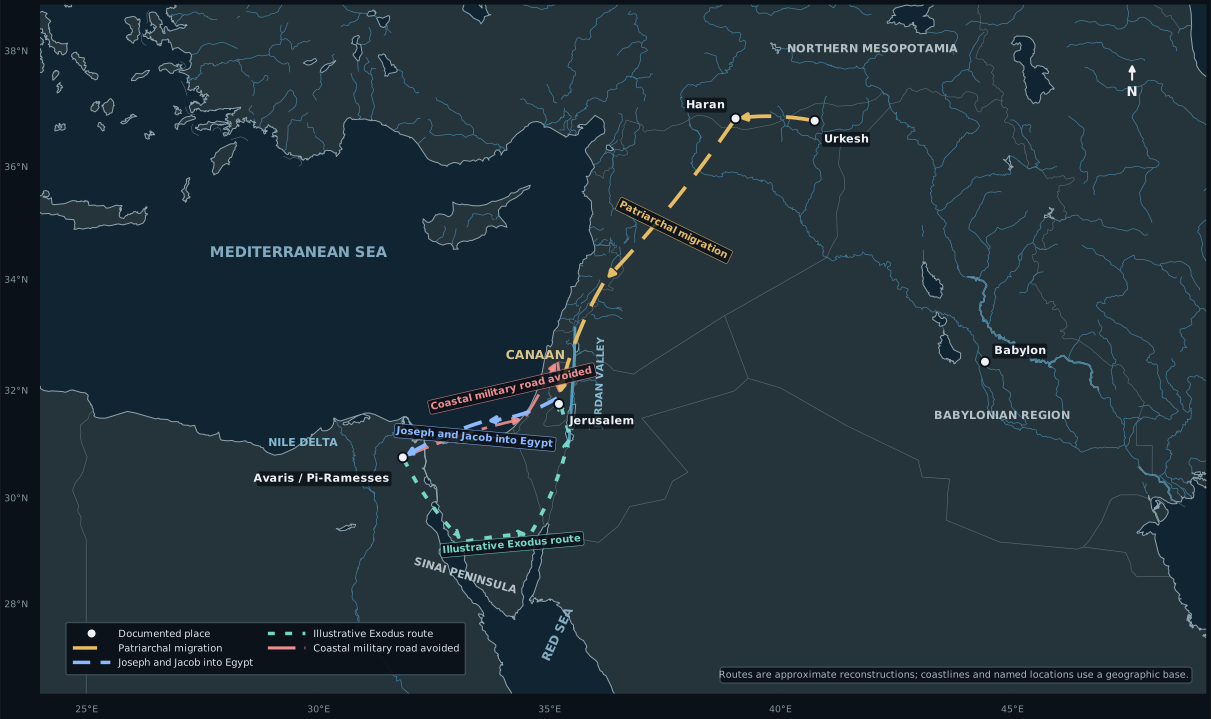
This project separates four questions that are often collapsed together: what the Bible narrates, what external history independently documents, whether a historical setting is compatible with the narrative, and whether a proposed identification is actually demonstrated.
Multidimensional evidence profiles
Every event is now evaluated separately for its historical core, date, identification, narrative detail or scale, and source control. A documented historical setting may coexist with a disputed biblical identification or a model-dependent date.
The earlier single confidence label remains available for filtering and backward compatibility, but it is no longer expected to answer every evidentiary question.
Chronological numbers
V24.1 explicitly classifies every chronology record by how its displayed coordinate is obtained: externally fixed anchor, externally controlled range, externally anchored disputed boundary, textual synchronism, historically constrained range, representative plotting coordinate, adopted model coordinate, relative sequence, schematic period, two-option window, or undated material. Date precision is kept separate from identification confidence and narrative historicity.
Primeval Period boundary
Genesis 1–11 remains textually undated on the master chronology. The separate Primeval Period research page now treats Adam as a deliberately multilayered research problem—evolutionary anthropology, psychological archetype, possible ancestral history, and theological synthesis, now including Cosmic Temple, Imago Dei, and a bounded ancestral-primordialization mechanism for how a remembered founder could acquire first-man significance—before tracing Cainite cultural origins, the Genesis 6 boundary episode, antediluvian memory, flood traditions, and Mesopotamian urbanism. Established context, interpretation, historical reconstruction, and speculation remain separate.
Model switching
Changing chronology models is not cosmetic. It changes dates and interpretations for Joseph, Moses, the Exodus, Israel’s settlement, Herod, and the birth of Jesus where appropriate.
Historical ranges and assumption firewall
Every event separates the plotted project coordinate from the wider historical range the evidence can bear. Major project hypotheses list their dependencies, what could weaken them, and which conclusions survive if they are rejected. The Historical Minimum model provides an externally constrained baseline without replacing the adopted reconstruction.
Integrated Research Threads
Cross-event dossiers can open as Research Threads from relevant timeline events. A thread follows one historical question across multiple chronological anchors, keeps evidentiary limits visible, and preserves the reader’s position in the master timeline. V24.4 adds a capstone Master Reconstruction & Final Red-Team that states what the project actually concludes and what would change if a disputed node failed.
Calibrated commitment and objections
The project distinguishes direct attestation, adopted reconstruction, favored inference, open questions, and rejected models. An inferential identification may still be the project’s preferred historical conclusion when the cumulative case warrants it; the interface should neither upgrade that inference into direct proof nor weaken it into agnosticism merely because it is disputed. Competing views remain visible as serious objections, residual uncertainties, and falsification tests, and each disputed node is given a dependency boundary showing what would and would not fall with it.
Post-biblical continuation
Events after the Bar Kokhba Revolt are presented on the dedicated Post-Biblical Jewish & Christian History timeline. Jewish history, Christian history, and shared context remain distinct overlapping tracks rather than one continuous institution.
Artifact evidence overlay
The main timeline can optionally display key or all linked artifacts. Marker placement indicates a curated chronological relationship; each marker retains a direct, corroborative, contextual, textual, or disputed label and links to the full Artifact Gallery dossier.
Textual and source control
Critical-edition records distinguish directly inspected witnesses from specialist-reported locators, while claim provenance keeps evidence, interpretation, inference, conclusion, and objection separate.
Early Exodus position
The c. 1446 BCE chronology is retained only as a Rejected Model Thread. The project concludes that it is premise-driven and historically untenable, while still presenting its strongest arguments and responses for audit. If the Exodus tradition preserves a substantial historical departure from Egypt, the only setting retained by this project is the reign of Ramesses II in the mid-thirteenth century BCE. Open the rejected-model audit →